The Frog Blog

The Frog Blog
Showing posts with label feedback. Show all posts

Sunday, 10 August 2014

Writing: Giving Feedback or "Critiques" (Part 3)

Writing: Giving Feedback or "Critiques" (Part 3)

Part 1 is found here and Part 2 here.

Continuing on from the previous posts about what are the aspects of critiquing one must be aware of, this week I'm going to show you the different ways a critic can deliver the goods and bads of a piece of writing. This list is by no means exhaustive and there is no one size fits all for giving feedback, and I'd love to hear about any other different ways you've come across.

The Shit Sandwich

A.K.A the Feedback Sandwich.

How it's done: literally what it says on the tin. You give one good point about the writing (the bread), then one criticism or suggestion of improvement (the filling; not necessarily "the bad"), and finish off with a good point (the bread). This can describe the entire bulk of your critique (a big slab of bread, a big dollop of filling, then a big slab of bread) or you can do several serving of bread-filling-bread.

One of the commonest ways of delivering feedback. It's not difficult to do and some people find it easier to give and easier to take, because the criticism is sandwiched between praise and therefore reduces the harshness of the impact. It also reinforces the fact that everyone has their good points that they should know to continue (but sometimes they don't realise what they're already doing is good!) and that every piece of writing has positives and negatives.


For others, because the criticism is sandwiched between the praise, the recipient places more attention upon the 'good bits' and neglect the 'bad bits', because "hey, because there are more praises than criticisms, I must be doing well, right?" So some critics feel the shit sandwich devalues the feedback.

Or on the other extreme end of the spectrum, the recipient places more attention on the 'bad bits' and the praise goes entirely over their head. Some may argue the first slice of bread acts as a warning sign that bad news is about to be delivered, so the recipient becomes deaf to both the first praise as well as the last praise, honing only onto the negative part.

Personally, I like it. It's simple, it preserves ego, it encourages establishment of teamwork, and it's a method a lot of people are used to. I alter it slightly when I critique so that I start with praise, then I deliver criticism, then I finish with an overall view, focusing mainly on the positives again with some reminders of negatives (e.g. There are some areas where head-hopping should be tidied up, as I mentioned earlier, and I think you should focus more on character development rather than so much on the action. Overall I think...), but I always end on something positive.
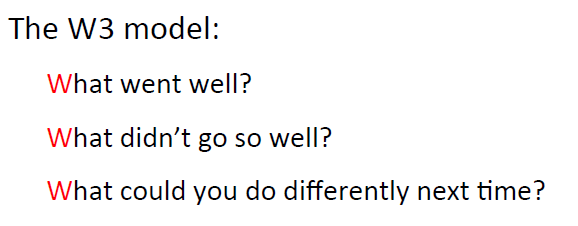
W3 Model

In critiquing, this is a different way of delivering feedback compared to the shit sandwich. Based on the three questions in your head, you highlight the pros, the cons, and also suggestions on improvement. If face-to-face, you can encourage the recipient to reflect on those questions themselves.

Remember, telling people "your tenses are all over the place and your characters come across as fake" may well emphasise their pitfalls, but, without suggestions for improvement, often that kind of feedback just damages ego without being very helpful. Just something simple such as "if you want to improve on tenses, one way of doing this is..." or "focus on what your characters really want and write their actions based on that, not what the plot dictates. You'll find the people more relatable and realistic that way."

Pendleton's 'Rules'

(From Pendleton D, Schofield T, Tate P, Havelock P (1984) The consultation: an approach to learning and teaching. OUP, Oxford)

Pendleton's 'rules' is pretty much the W3 model but integrates both the recipient's views as well as the critic's. This takes more time, but the interaction builds rapport and emphasises the teamwork aspect of giving feedback. Even without working face to face you can easily start by replying to the critique request with "Can I just ask you to PM me your answers to these questions *insert W3 questions here* and then I'll send you my thoughts?"

First, the critic has to clarify factual details. As mentioned in Part 2, Point 8 of Ende's Principles state feedback should be "on decisions/actions versus assumed intentions/interpretations." Someone has commented recently on my story, "I'm not sure if it's intentional, but your character comes across as one who doesn't fit his role and it's hard to relate to him." Now, if I were trying to make him as a shirker with a personality that is cold and unlikeable, I've succeeded. In reality, that character is actually the teacher who has his best interest in his students and is meant to be the rock of the team -- so I've actually failed!

What the commenter (she's not even my critic, but her comment was most helpful!) has basically done is highlight something that didn't sit well with her, but clarified it with me in case it was mistaken. Cluttered sentences can represent a writer who doesn't have the full grasp of the English language; alternatively it can also represent a cluttered mind. What was the writer trying to achieve? 

Next, you and the recipient both partake in the W3 Feedback. The result is this:
  • Clarify Facts
  • Recipient comments on pros
  • Critic comments on pros
  • Recipient comments on cons/areas for improvement
  • Critic comments on cons/areas for improvement
  • Both discuss areas to focus on to change
The last part is to emphasise the teamwork aspect, again. Although the writer may see their punctuation as the main problem, they may not be aware that their head-hopping is confusing and takes away from the story far more than their missing question marks. As the critic, it will be beneficial if you can both come to an agreement as to the biggest points to focus on. After all, remember Ende's Principles Point 4: feedback should be "regulated in quantity and limited to remediable behaviours." We can't improve everything at once!

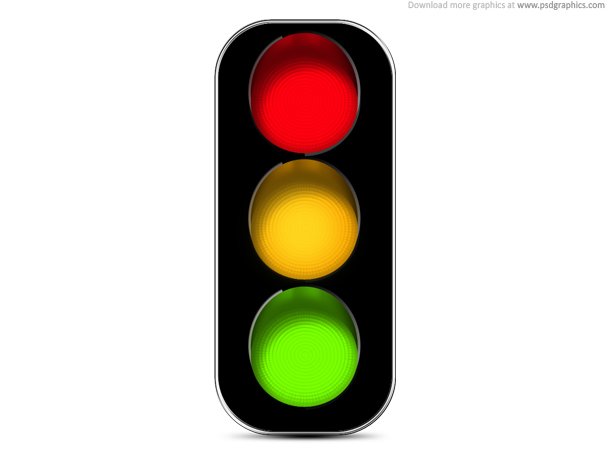
Traffic Lights

This is an alternative to the shit sandwich, which is also quick and helpful.

Red light is where you state something that the writer should stop. For example, they should stop head-hopping, or stop jumping in tenses, or stop the endless flashbacks. Try and prioritise the most important bit(s).

Yellow light is where you state something the writer should change. For example, they should slow down on the pacing because everything is developing too quickly, or they should try to show more than tell, or avoid starting consecutive sentences with the same word as it becomes repetitive.

Green light is where you state something the writer should continue. For example, they should continue showing us character interactions as it's good development, or interlacing the surroundings with actions so there isn't obvious info-dumping or the pace isn't altered, or keep up the sarcastic internal commentary by the MC because that's what makes him/her so endearing.

A variant of this is "Start, Stop, Continue". Basically what it says on the tin.

Miscellaneous

I also find phrasing certain criticism as questions not only makes it more palatable for the recipient, it also makes them think. For example, if the MC is acting out of character, one can say, "I don't understand why she went for the gun. If she's shy and untrained in weapons, wouldn't run?" or "Why did the character do *insert surprising out-of-character action here*?"

What to Give Feedback On

This may be a point some people are wondering. Now that I've covered principles of giving feedback and methods of delivering it, there remains the question of quite what we're delivering. You can remember the theories of critiquing and package it nicely, but the contents are the important parts. What should you comment on? The character? The setting? The story delivery? The grammar?

It's up to you as the critic. First of all, what part of the writing worked for you? Some points you may consider are:

  • Structure of the story e.g. clear setting, clear characters, 'starting with the action' or inciting incident, obvious conflict, logical sequence of events
  • Voice e.g. the main character's internal thoughts, the storytelling voice of the writer
  • Content e.g. is there evident info-dumping? Is the exposition well-balanced? Are any bits too long-winded?
  • Conflict e.g. is it original? Is it a fresh twist? Is it obvious? Is it tragic? Is the hook good?
  • Characterisation e.g. is the character realistic? Relatable? Hateworthy? One-dimensional? Self-obessed? Are any of the traits intentional? What are their motivations?
A note about grammar and punctuation: as critics, we are not editors, whose job is to tidy up those sticky sentences and missing apostrophes. Of course, prose with poor English grammar and punctuation makes for difficult reading, but please don't nitpick on every missing full-stop. If the writing is jarring in that sense to the point where it distracts from reading, just write one quick sentence on it (something like "Consider tidying up some of your sticky sentences as the phrasing can be awkward and difficult to understand" or "Remember commas always come at the end of dialogue if ending with a speaking verb"), but don't harp on about it. It's not your job.

Credit goes to Jenny Rosen on Wattpad for passing on her experiences of critiquing that made the "What to Give Feedback On" part possible.

Final Words

Critiquing is a learning curve. I've learned so, so much in just under a year's experience of critiquing. I started off as one of those arrogant critics where I highlight every negative and never praise, thinking "Well, writers need a tough skin so they might as well develop it now." Well, I've learned now that's not the way to do it. I'm not a publishing house or an agent. I don't need to be so harsh, and putting people down does nobody any favours. The bottom line for critics, at least on Wattpad in my opinion, is to be nice and be helpful. If a piece of work is so poor you don't think you can even summon a nice sentence for it, don't critique it.

I hope this three-part blog post on critiquing has been helpful and informative. I reiterate the fact that I have no professional credentials and do not claim to be an expert in any shape or form. I relay my own experiences and what I have read and been taught in the hopes that my posts will be of benefit for fellow writers and critics. Remember, writing and critiquing is something we all will benefit from, and there is nothing more valuable to a writer than good old constructive criticism.

Sunday, 3 August 2014

Writing: Giving Feedback or "Critiques" (Part 2)

Writing: Giving Feedback or "Critiques" (Part 2)

(See here for Part 1.)

So let's continue going through Ende's principles and what they mean for us as critics or readers who give feedback.

A reminder of what Ende's principles entailed:
Feedback should be:
1) Well-timed and expected.
2) Teacher and trainee working as allies with common goals.
3) Based on first-hand data.
4) Regulated in quantity and limited to remediable behaviours.
5) Phrased in descriptive non-evaluative language.
6) About specific performances, not generalisations.
7) Clearly labelled 'subjective' as appropriate.
8) On decisions/actions versus assumed intentions/interpretations.

5) Feedback should be phrased in descriptive non-evaluative language.

This is actually relatively simple and I'm sure most people who give feedback are aware of it, consciously or otherwise. Feedback should focus on what went well and what did not go well objectively (i.e. "non-evaluative" and not in your opinion.) (Subjective comments will be discussed in point 7.) It should be about the work of the writer and not the writer him-/herself. Telling them how rubbish they are at storytelling is about the most useless thing you can say to anyone.


6) Feedback should be about specific performances, not generalisations.

Again, a relatively simple point that most people are aware of. Considering feedback is actually directly from reading the writer's piece, this can't go wrong in critiquing. Remember you're critiquing the piece that's in front of you, and therefore the feedback should be about that very piece. Saying "The world-building you've employed in the book is very rich and I can obviously see you've put in a lot of effort making your story unique" is helpful; saying "Most fantasy stories are boring and long-winded" is, again, utterly useless, as it doesn't reflect on the particular piece of work you're critiquing and the writer can't employ it to improve their work.


7) Feedback should be clearly labelled 'subjective' as appropriate.

As mentioned earlier, feedback should be non-evaluative and objective. Additionally, because you're a reader as well as a critic, in my opinion, you should also be justified to give your opinion (i.e. subjective feedback) on the piece of work. However, you need to state clearly where you are stating your own opinion as opposed to objective feedback.

An infamous way of starting a story is with a dream sequence. Now, I'm sure we've all read a book where it started with one and was used effectively, adding something wonderful to the book. However, most books, particularly those written by amateurs and writers-in-training, do not use that trope well. Is the book necessarily 'bad' because it had a dream sequence? Not necessarily. If the writer is good enough, they can pull it off.

Now, just because a book started with a dream sequence and you don't think they pulled it off well, you should say that -- you didn't think it was done very well, as opposed to it wasn't done very well. Because such a use may actually appeal to some readers, you shouldn't label your opinion as facts.


If there is a book that makes your eyes twitch a bit more than you would like and you've used up your arsenal of "I think this isn't working..." and "I don't really like that part", then below are some good stock phrases for you to use and makes the criticism easier to swallow.

  • Some people may find the way you've portrayed Lily as a bit too Mary-Sue-like. (note *some* people may feel that way. Not necessarily you, the critic, but some people! This is phrased so it's not as intense as the "I'm telling you this, therefore I am correct!" line that some critics like to apply.)
  • Personally, I wouldn't phrase the second sentence the way you have. It may be better if you wrote it like this... (Notice it *may* be better, so you're leaving the power to change up to the writer. They don't necessarily have to take your suggestion on-board -- as with all critiques! -- but they'll know it could help them if they do.)
  • You may find if you left the contents of paragraph two until later in the book, your readers will be more interested as there is an air of mystery maintained. (Again, less personal in how it's presented.)
  • Consider changing the way you're describing the city as you're stopping the flow and just describing the aesthetics -- you may want to pepper the description around instead. (Again, empowering the writer to apply the changes, giving them the choice to *consider* changing).


8) Feedback should be on decisions/actions versus assumed intentions/interpretations.

Slightly more difficult in writing, because prose is open to interpretation and everyone views a sequence differently. It may very well be very different to what the writer had in mind, also. What this point means is you should be feeding back on what the writer was doing, rather than what you think they were trying to do. For example, this can be the difference between a writer utilising purple prose (i.e. superfluous language) and a writer trying to portray someone who is meticulous to detail, who is describing everything simply because it's part of their personality.

How do you avoid mistaking intentions as mistakes? Well, sometimes it's obvious what the writer is doing; other times, it's not as obvious. If in doubt, you can say "It looks like you were attempting to..." or "It seems to me you were going for..." This leaves room for the writer to correct you if you are mistaken and also allows a more cautious approach, as well as flagging up to the writer that this part of the critique is how you interpreted the prose (subjective), rather than absolute (objective).

As critics, I believe we should strive for a balance between support and challenge. On the one hand, you need to effectively criticise their work, highlight the flaws, flag up the deficits, so the recipient knows their pitfalls and where to improve on. On the other hand, you don't want to overwhelm them on what is effectively their own deficiencies in writing. You want to help and encourage, not demoralise or patronise. At the same time, you need to challenge the recipient so they can get better, not just feel better about their works.

The most important point is to work as a team. Again, as I mentioned in the previous blog post, do not aim to crush the recipient's soul. That is not your job.

A reminder of Ende's principles:
Feedback should be:1) Well-timed and expected.2) Teacher and trainee working as allies with common goals.3) Based on first-hand data.4) Regulated in quantity and limited to remediable behaviours.5) Phrased in descriptive non-evaluative language.6) About specific performances, not generalisations.7) Clearly labelled 'subjective' as appropriate.8) On decisions/actions versus assumed intentions/interpretations.
How good are you at practising them? What are your flaws as a critic? What areas do you think you are the best at and the most deficient in?

I'm running out of time to write this week, but next week I shall talk about methods of delivering feedback, when I will be showcasing the shit sandwich (sorry it'll be a week late!).

Tuesday, 29 July 2014

Writing: Giving Feedback or "Critiques" (Part 1)

Writing: Giving Feedback or "Critiques" (Part 1)

We, as writers (whether amateur, "hobby", or professional), are forever seeking to better ourselves and to improve our craft. Often, we will seek feedback from others regarding our work, often in the form of critiques.

We may even give out critiques ourselves, to friends and to fellow writers. As with all skills, "critiquing" has a learning curve and today I would like to talk about what I've learned about being a "critic" or a giver of feedback in the past year or so: what I do, what I found I should not do, and what good techniques I've come across.

I've made my fair share of mistakes in the past and I'm sure I will make many more in the future, but I hope this will be an interesting read and may help others in bettering themselves, whether as a writer or a critic, or both. And I hope you won't make as many mistakes as I did!

What are my credentials?

On Wattpad, I am what they call a "critic", that is: I offer my thoughts and knowledge on writing to others who request my "service". Both as a writer and as a critic I have a long way to go, but I do try my best to help others improve and also offer my thoughts on their writings as a reader.

What are my qualifications? How many books have I published? What mind-blowing literature pieces have I created to take the world by storm?

None. Well, I got two A*s in English Language and English Literature at GCSE level (16 years old), but I never pursued the languages beyond that point, favouring the sciences and maths instead and am studying those at university level. However, I am a very, very avid reader. I've been devouring books since I was young and that hasn't changed as an adult, although a few research papers have been thrown into the mix, too. Although my sub-par school curriculum offered little to no grammar lessons, I learned a lot about writing through reading. In the past year on Wattpad, I've also learned from fellow critics about the art of writing as well as the art of critiquing and have "published" a few novels and short stories on that site.

Is this post the absolute law in how one conducts oneself as a critic and how prose must be written? Of course not! I'm just expressing my views based on my own personal experience -- and I have made numerous blunders in the process -- and how I feel one can be a thorough and, above all, helpful critic. My methods may not work for everyone and I still have lots to learn, but I hope it can help others give feedback when they critique or when they comment on a story.

What is feedback? (From Oxford Dictionaries online)

Critique: a detailed analysis and assessment of something, especially a literary, philosophical, or political theory. 
Feedback: Information about reactions to a product, a person’s performance of a task, etc. which is used as a basis for improvement.
Basically, we analyse and assess how good or bad something is -- with the aim to help them improve.

So the backbone of giving feedback is: do not aim to crush the soul of the recipient.

Of course, there are some who are sensitive and insecure about their writing skills. We've all been there. There are those who don't actually want the flaws in their work highlighted and don't actually want you hammering at them about ways they can improve their wares. There are those whose skills are actually much lower than yours -- think of a maths professor teaching at university level teaching their kid how to do addition (only in terms of the difference in skill, as I'm not claiming to be a professional in the slightest), he/she wouldn't be teaching them them mathematical modelling or all kinds of complicated algebra. So you've got to alter your expectations and advice according to the recipient...

...if they wanted a critique in the first place.

Back to the start of the past paragraph. Remember not everyone wants a critique. You may go in, full of good intentions and hoping to aid this young budding writer to become a fully-fledged writer, but they may be happy plodding along at their level. Then your (perhaps too) hardcore critique came along and made them upset about writing, instead of helped them improve. They didn't want their stories to be picked apart. They didn't ask for it. So don't, no matter how good your intentions are. If they wish for a critique, offer it or wait for them to ask. Feel free to give small prompts about improvement -- things like "I think XXX should probably talk about his past a bit more because it makes him seem more realistic" and "I think that last action scene went a bit too quickly. I think if it was paced a bit steadier I can really feel myself in that battle" is quick and helpful.

With the above in mind -- Help the recipient improve. Critique only if your service is required. -- let's talk about how feedback should (theoretically) be given and we can have a look in further detail about the above two points.

Ende's Principles of Giving Feedback

Years and years ago, in the long-gone days of 1983, a man named Ende published a scientific article on giving feedback [Ende J (1983) Feedback in clinical medical education. Journal of the American Medical Association 250:777-781].

Basically, it boils down to the following:
Feedback should be:
1) Well-timed and expected.
2) Teacher and trainee working as allies with common goals.
3) Based on first-hand data.
4) Regulated in quantity and limited to remediable behaviours.
5) Phrased in descriptive non-evaluative language.
6) About specific performances, not generalisations.
7) Clearly labelled 'subjective' as appropriate.
8) On decisions/actions versus assumed intentions/interpretations.

So what does this all mean?

1) Feedback should be well-timed and expected.


As mentioned earlier, critiques should be something the recipient is expecting, so either the recipient must have approached you asking for one or you offered one to them and they accepted. (Equally if they stated on their profile they love getting feedback, that can also be taken as consent.)

It should be well-timed. Although not much of a problem on Wattpad, because the book isn't going anywhere, the fresher the feedback relative to the time of performance (i.e. of writing the book), the more the recipient will understand your feedback compared to what they were thinking at the time of writing. Additionally, it's a matter of courtesy that you don't promise someone feedback soon and deliver it a few months later. At least drop them a PM either letting them know it'll take a while or apologising profusely for being late.

2) Feedback should be teacher and trainee working as allies with common goals.

Note that although the critic isn't a teacher, they are giving advice to the recipient, so this sentence can be adapted to our use. Also note the use of the word allies. The critic shouldn't be antagonising in any part of the critique. The critic is working with the recipient so that the recipient can improve their writing.

You may disagree with the writer and vice versa, but try to maintain a degree of professionalism even if you can't reach an agreement. Remember you're using your time to help another person improve their skills. Making them resentful or your enemy means they won't take any of your feedback on-board. Bruised egos and heated arguments aside, antagonism results in you wasting your time critiquing.
3) Feedback should be based on first-hand data.

This means literally what it says. You should feedback based on what you've read, rather than, for example, what other people have said in the comment section or mentioned in their reviews of that piece. You should gather your own data and make a judgement based on that.

Consider quoting the recipient so the feedback is more specific, for example:

"I noticed you're showing on top of telling on some occasions, and frankly I think you can easily just show and leave out the telling. One area where this is obvious is in paragraph 2, sentence 5, and another area is paragraph 6, sentence 1."

"Where your character said, 'quote quote quote' I feel you can better show her annoyance if you used this word instead of that. As it stands, I think it conveys more sadness than irritation."
4) Feedback should be regulated in quantity and limited to remediable behaviours.

Now the former is something I especially struggle with. Feedback shouldn't be overwhelming in numbers (of points) and should be restricted to things upon which the recipient can improve.

We all know nobody can change everything at once. As a critic, try and prioritise the points the recipient need to improve. What's more important, the fact that their tenses jump back and forth, or they don't know how to punctuate dialogue, or the fact that their main character is difficult to relate to because of personality issues? Or is the fact that the basics of the English language haven't been fully grasped yet the most important area to focus on -- because you, as the reader, is having great difficulty understanding what they're actually trying to convey?

Nobody likes having all of their bad points listed, so consider expanding on the biggest problems and either PM'ing them the smaller points or just having a sentence or two about the lesser areas, for example:

"Just a few minor errors regarding dialogue punctuation. Remember to end a spoken line with a comma if followed by a speaking verb; otherwise, you should end in a full-stop."

"I notice you're occasionally spelling the word 'weird' wrong. Remember the 'e' goes before the 'i', but that's a small issue."

In terms of remediable behaviours, this refers to raising points that the user can actively improve on. It isn't a major issue in writing, in my opinion, but consider when you're public-speaking, you're told your accent is too heavy to be understandable -- it's asking a bit too much if you request a change of accent, but maybe you can suggest they enunciate clearer and speak slower. 

Part 2 can be found here.

What do you think of Ende's principles so far? Do you implement any of those? Do you disagree with any of them?